

The Best Time to Feed Your Cat: A Simple Guide to Healthy Feeding
Feeding your cat at the right time is an important part of maintaining a healthy and comfortable daily routine. Cats are creatures of habit, and many of them feel more relaxed when meals are provided on a predictable schedule. While there is no single feeding time that is perfect for every cat, establishing a consistent routine can help you manage portions, monitor appetite, and understand your pet’s normal behavior.
So, what is the ideal time to feed your cat? For many healthy adult cats, feeding two meals a day can be a practical option. A morning meal and an evening meal provide a simple structure while allowing enough time between meals. However, the best schedule depends on your cat’s age, health, activity level, food type, and individual preferences.
Why Feeding Time Matters for Cats
Cats naturally prefer routines. When your cat receives its meals at approximately the same times each day, it can learn when to expect food. This predictability may help reduce unnecessary begging and make it easier for you to monitor how much your cat is eating.
A regular feeding schedule also makes changes in appetite easier to notice. If your cat normally finishes its meals but suddenly refuses food or eats significantly less, you are more likely to recognize the change when you follow a consistent routine.
Feeding times can also be coordinated with play and other daily activities. For example, some owners prefer to schedule an interactive play session before a meal, creating a predictable pattern of activity followed by eating and resting.
What Is the Best Time to Feed an Adult Cat?
For many healthy adult cats, two meals per day can work well. A simple schedule might look like this:
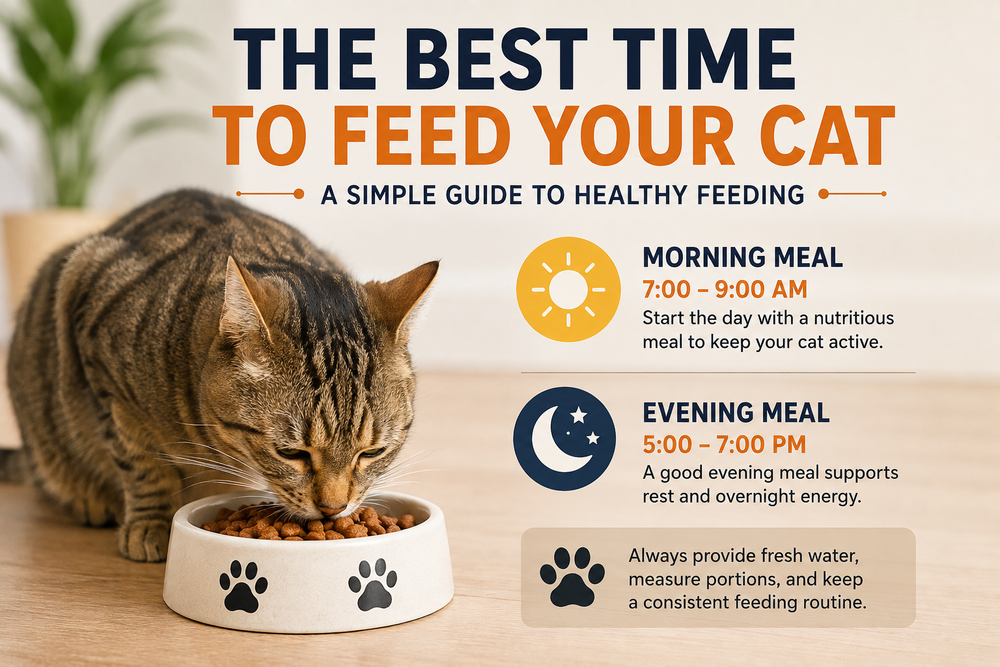
- Morning: Around 7:00–9:00 a.m.
- Evening: Around 5:00–7:00 p.m.
These times are only examples. You can adjust them according to your own schedule and your cat’s needs.
Consistency is generally more important than choosing an exact hour. If you feed your cat at 8:00 a.m. and 6:00 p.m., try to maintain similar times each day.
Some cats may prefer smaller meals more frequently. In these cases, dividing the daily food allowance into several portions can be useful, provided that the total amount of food remains appropriate.
Should You Feed Your Cat Before or After Playtime?
Cats often enjoy short periods of activity throughout the day. Interactive play using toys can provide physical exercise and mental stimulation.
Some owners choose to play with their cat before feeding. This can create a natural routine: play, eat, groom, and rest. However, there is no requirement that every cat must follow this exact pattern.
The most important consideration is that your cat receives enough appropriate food and has a routine that works comfortably for both of you.
How Often Should a Kitten Be Fed?
Kittens have different nutritional requirements from adult cats because they are growing rapidly. Younger kittens generally need more frequent meals than adult cats.
Instead of providing only one or two large meals, kittens may benefit from several smaller meals spread throughout the day. The exact feeding frequency depends on the kitten’s age, size, development, and the type of food being provided.
Kitten food should be specifically formulated to support growth and development. If you have a young kitten, your veterinarian can recommend an appropriate feeding schedule and portion size.
Is Free Feeding a Good Idea?
Some cat owners leave dry food available throughout the day, allowing their cat to eat whenever it wants. This is known as free feeding.
Free feeding can be convenient, and some cats are able to regulate their food intake effectively. However, it may not be suitable for every cat. Some cats may eat more than they need when food is constantly available, which can contribute to excessive weight gain.
Scheduled meals make it easier to measure your cat’s daily food intake and monitor changes in appetite. This can be particularly useful for cats that need help maintaining a healthy body weight.
How Much Food Does a Cat Need?
Choosing the right feeding time is only one part of proper cat care. The amount of food your cat needs depends on several factors, including age, body size, activity level, metabolism, and whether the cat has been spayed or neutered.
Always check the feeding recommendations provided on your cat food packaging. These recommendations are general guidelines, so the ideal amount may vary from one cat to another.
If you are concerned about your cat’s weight or nutritional needs, a veterinarian can help determine an appropriate daily calorie and feeding plan.
Wet Food or Dry Food: Does Timing Change?
Both wet and dry cat foods can be part of a balanced diet when appropriately formulated for your cat’s needs. The choice may influence how you organize meals.
Wet food is often served at specific meal times because it should not be left out for extended periods. Dry food, on the other hand, can be easier to portion and may be suitable for scheduled meals or, in some cases, controlled free feeding.
Regardless of the food type, fresh drinking water should always be available.
A Simple Daily Feeding Routine
A practical routine for an adult cat could look like this:
8:00 a.m. — Morning Meal
Provide an appropriate portion of complete and balanced cat food and make sure fresh water is available.
During the Day — Normal Activity
Allow your cat to explore, rest, and play according to its normal routine.
6:00 p.m. — Evening Meal
Offer the second portion of the cat’s daily food allowance.
Evening — Play and Rest
A short interactive play session can provide exercise and mental stimulation before your cat settles down for the night.
This schedule can be adjusted to suit your household. If your cat needs smaller and more frequent meals, the daily amount can be divided into additional portions.
Signs That Your Feeding Routine May Need Adjustment
Every cat is different, so it is important to pay attention to behavior and body condition. Constant begging, rapid weight gain, unexplained weight loss, repeated vomiting, or a sudden change in appetite may indicate that the feeding routine or diet needs to be reviewed.
A sudden refusal to eat should not simply be assumed to be normal behavior, particularly if it continues or is accompanied by other concerning symptoms. In such situations, contacting a veterinarian is the safest approach.
Final Thoughts
The ideal time to feed your cat is not necessarily a specific hour on the clock. For many healthy adult cats, two consistent meals a day can provide a simple and manageable routine. Other cats may do better with smaller meals divided throughout the day.
The most important factors are providing an appropriate, balanced diet, controlling portions, keeping fresh water available, and maintaining a feeding routine that matches your cat’s age and individual needs.
By observing your cat’s eating habits and maintaining a predictable schedule, you can make mealtimes more organized and support good everyday care. If your cat has a medical condition, unusual eating behavior, or special nutritional requirements, consult a veterinarian for personalized advice.